

My husband and I live with our two cocker spaniels in a village near Cambridge - which is thankfully in the catchment for the excellent Addenbrookes hospital. I’d not thought much about it before, that was until my GP made an urgent referral for me to the Gynae Oncology department there last summer.

A range of symptoms
Initially, I went to the GP in May 2024 due to severe headaches. They ran a full range of blood tests, put me on blood pressure medication and a high dose of Aspirin to take for six weeks. The blood tests all came back in normal ranges but six weeks later, having had more headaches with visual disturbance, my GP made an urgent referral for an MRI of my brain with concerns about a TIA (mini stroke).
I'd also noticed a bit more indigestion and occasional stomach cramps, but it was mainly on days I was working in school, so I put it down to being busy and not eating or drinking well.
When I started to have a small amount of post-menopausal bleeding my GP was concerned again and made an urgent referral to Gynae Oncology at Addenbrookes Hospital. She did warn me then that it could be cancer.
In July, I had the MRI which came back as ‘normal’. This was followed by two ultrasound scans which revealed a small polyp in my uterus - a potential cause of the bleeding. However, they also revealed I had masses on both of my ovaries.
I had a CA125 blood test and a hysteroscopy to remove the polyp which was sent to histology. I was immediately taken off the HRT meds I’d been on for 18 months which proved to be the cause of the headaches - they stopped immediately!
Getting a diagnosis
The polyp was normal and my uterus looked healthy however my CA125 came back as 445 – way above the normal range of 0-35. I was booked in for an urgent chest/abdominal CT scan with contrast that revealed it was most likely cancer, and I was initially staged at 4B.
A laparoscopy was carried out to get samples, but during the procedure surgeons decided not to take any as they didn’t want to risk disrupting any cancer cells.
After the Multi-Disciplinary Team (MDT) had discussed the results of all the tests in early August, a plan was agreed. The surgeons were very optimistic that a cytoreductive (debulking) surgery and adjuvant chemotherapy would be the best approach.
Lyndsey, a specialist Gynae Oncology nurse, was brilliant in taking time to make sure I understood everything and answered my many questions. Luckily, I could also talk at length to my friend Chris who had been treated at the same hospital seven years before. She was happy to share so much information about the operation and what to expect with chemotherapy which was a great help.

A modified radical hysterectomy
I had my surgery on 2 September. Any visible signs of cancer were removed, along with a few extra areas as a preventative measure – peritoneum, omentum, ureter, appendix.
I spent seven days in hospital post-surgery, which was actually the bit I was most worried about, but all the staff and other patients were lovely.
Any pain I had was managed really well and I was relieved to finally get mobile again. Lyndsey came to see me on the last day to chat through the next steps and gave me the confidence to get through the next few months.
I was finally graded as Stage 2B. The disease hadn’t spread out of the pelvic area and no damage was done to my bowel or bladder during the operation. I had also consented to genetic testing which showed there was no genetic mutations in BRCA1 or 2 present. A real relief for me, my two grown-up daughters and young granddaughter.
Starting chemotherapy
After resting and gentle exercise for six weeks, I met the Gynae Oncology team and dates were set for my adjuvant chemotherapy. First, I had to have a procedure which involved being injected with a radioactive tracer to check my kidney function - in the Department of Nuclear Medicine no less!
What a fantastic team of experts and again all very optimistic. My lead oncologist is Professor James Brenton who also leads on research into ovarian cancer.
My first chemotherapy session started on 10 October, and I had six rounds in total. Once every 21 days. The sessions started at 8am and were usually completed by 3pm.
My main side effect was leg weakness and pain; this came on within two days. I was very lucky not to have nausea, diarrhoea or any changes to my smell/taste.
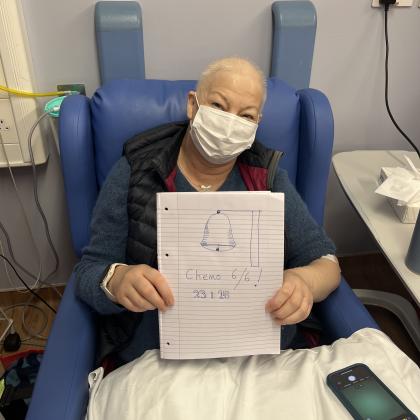
I chose not to wear a cold cap, and my hair started to fall out just before my second session. My husband Nigel shaved it short to help and I did have a wig fitted but rarely wore it. I felt more comfortable wearing a range of hats. The specialist hairdresser did give me one great piece of advice: “keep putting your ‘face on’ so when you look at yourself in a mirror, you’ll feel better”. It certainly worked for me and Nigel could tell when I was having a bad day as I didn’t have the energy to do it.
Managing medication and side effects
January and February were the worst months. After my fifth chemo session I started to feel really low and had some very dark thoughts.
I struggled with concentrating on anything for more than a couple of minutes and felt really unsettled. My immunity had also dropped by this point and I had to stay safe which meant it got lonely at times. I wasn’t able to see my daughters or granddaughter for months due to working at a school and starting nursery – so many germs!
I’d been put on medication to help with my leg pain, but it can cause low mood. Professor Brenton listened and immediately stopped it along with the injections I’d had due to my low blood counts after fourth session.
My final session at the end of January was much better with fewer side effects.
Finding the Yoga and Relaxation sessions
Finding Target Ovarian Cancer and the weekly yoga and relaxation sessions has been one of the most positive things in my recovery. I knew I needed to strengthen my abdominal muscles and learn to relax, but I didn't feel up to joining any community classes. When I saw that the yoga classes were delivered online, it felt like the perfect fit.
I was a little apprehensive about joining, especially as I’d never tried yoga before, but I needn’t have been as Maya and Claire were so welcoming.
I found Claire’s expertise and style of teaching brilliant and I still look forward to it each week as she always varies the stretches and the relaxation routine. I know I’m in such safe hands with Claire and it’s a date firmly in my diary now.
My Oncology team were happy I’d found the sessions as well, and I’ve recommended them to the Occupational Therapist who specialises in exercise for women who’ve had abdominal surgery like mine.
Active surveillance
I’m now on ‘active surveillance’ and have had two CT scans so far which have thankfully shown no signs of disease. One did show I had a DVT in my vein at the top of my leg so I’m now on medication until September to prevent any more forming. The oncologists confirmed it is a side effect of the chemotherapy.
My bloods have been checked monthly, and my CA125 blood test results are considered a good indication of what’s happening and are now at 8.
The routine of blood tests and chemotherapy was reassuring as much as it was challenging. Once all that stops and you’re moved to the surveillance group, you do feel a little alone and that’s also where I’ve found Target Ovarian Cancer’s online communities so helpful providing much needed information. My next telephone appointment and blood tests are in three months' time.
Spreading the word
I’ve been so lucky with the support of friends and family on my journey, and they’ve all continued to be amazing helping Nigel and I raise nearly £3,000 for Target Ovarian Cancer.
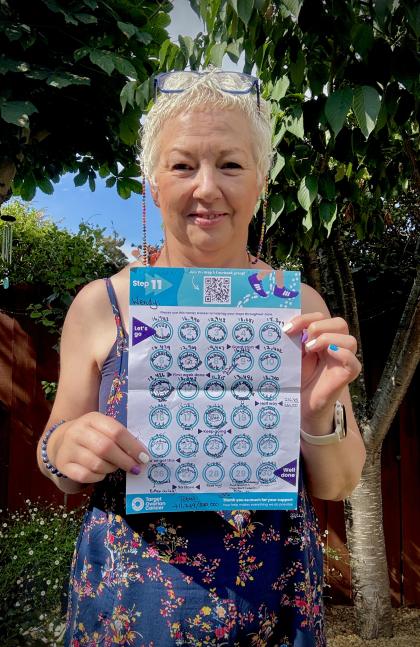
We’ve just completed the Step 11 Challenge, and I’m so pleased to be well enough to walk so far and give back to the charity. Our favourite walks were on the north Norfolk coast with our two dogs!
I documented the challenge with little videos and enjoy watching it back. I didn’t realise how much my hair has grown (lots of chemo curls!) and how I’m getting more confident out and about without a hat.
In addition to saying a big thank you through fundraising, I’m really keen to spread the word and get more information from Target Ovarian Cancer out into the community. My current focus is on GP surgeries, hospital clinics and education settings where a very high percentage of staff are women over 40 – having been one of them myself.

If you’ve been affected by this story and would like to speak to a specialist nurse, you can call our dedicated support line on 0808 802 6000 or contact us: [email protected]. We're open from 9am until 5pm, Monday to Friday.
If reading this story has helped you, join the Ovarian Cancer Community to connect with more people affected by ovarian cancer.