
On this page:
- How does treatment for ovarian cancer affect my fertility?
- Talking about fertility
- Fertility options
- Other family building options
- Psychological impact
Ovarian cancer treatment can affect your fertility (your ability to have children). You may not be sure if you want children in the future, or you may be diagnosed at an age when you were planning to start a family. Any impact on fertility can make an ovarian cancer diagnosis even harder to cope with.
It’s normal to feel a range of emotions, and it can be overwhelming to talk about this. For more support:
- Call our support line.
- Your treatment team can signpost you to local support groups and counselling, ask your CNS for help finding local services. We also run local support groups and we have a local support directory where you can search for support groups near you.
- Reach out to others in a similar situation through our online communities.
- Maggie’s centres offer specialist support and counselling.
- The British Infertility Counselling Association (BICA) is a directory of specialist professional counselling focusing on any stage of fertility treatment or for coping with infertility.
- Cancer fertility and me have information on fertility preservation options before undergoing cancer treatment.
How does treatment for ovarian cancer affect my fertility?
Ovarian cancer treatment may mean both ovaries and fallopian tubes, and the uterus (womb) are removed in surgery.
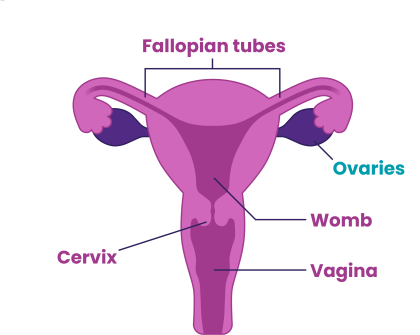
This means you won't be able to become pregnant naturally but you may still have other options.
If you have been diagnosed with certain types of early-stage ovarian cancer and the cancer is only in one ovary or fallopian tube, it might be possible to keep your uterus (womb) and the other unaffected ovary and fallopian tube. This is called fertility-sparing surgery.
Your treatment team will discuss this with you before your surgery. It depends on both your type and stage of ovarian cancer if fertility-sparing surgery is an option for you.
If you have fertility-sparing surgery, it means you may still be able to have a child in the future. However, treatments such as chemotherapy may damage your remaining ovary and egg supply or increase your risk of an earlier menopause.
Talking about fertility
It's important to discuss your fertility with your team before treatment starts. This will help you, your partner, if you have one, and your treatment team plan the most appropriate treatment for you.
- You may be able to speak to a fertility counsellor. They will be able to help your decision making, inform you of your choices and support you emotionally.
- You should also be able to speak to a reproductive medicine specialist. This is an expert in fertility who will work with your treatment team to coordinate any fertility sparing tests or procedures, such as egg or embryo freezing, within your overall ovarian cancer treatment plan.
Sometimes having a discussion about fertility needs before treatment starts is not possible. If treatment has to start immediately or you've been diagnosed through emergency surgery, you may want to talk about your options after the treatment, when you feel ready.
Your clinical nurse specialist (CNS) or oncologist can talk to you about accessing fertility counselling and provide referral letters for your GP and other fertility services.
A discussion about your fertility and treatment options could include:
- Are there any options to change my ovarian cancer treatment plan to preserve fertility?
- Is fertility counselling available?
- A realistic assessment of your chances of getting pregnant after treatment
- A full and honest discussion about the impact of cancer on your life.
- Thoughts about the impact on any children you may have already or plan to have in future if treatment doesn’t prolong your life. This should also include the impact on your partner if you have one.
- Options for fertility treatment, including the costs if you choose to fund this privately.
Fertility options
Freezing eggs, embryos or ovarian tissue
Depending on the type and stage of ovarian cancer you have, and how quickly you need to start cancer treatment, you might be able to have your eggs collected and frozen before ovarian cancer treatment. This process involves injecting hormones to stimulate your ovaries so that they produce eggs. This takes around two weeks. Then doctors collect the eggs, freeze and store them in order to keep them for future use.
Collecting your eggs should ideally happen before ovarian cancer treatment because chemotherapy can damage them. If this isn't possible, your team may be able to collect eggs at least six months after finishing treatment, to give your ovary time to recover.
The same freezing process can be done for embryos. Once your eggs are collected, doctors would use your partner or a donor’s sperm to fertilise them, which creates embryos. These embryos are then frozen and stored until you decide you're ready to try to have children.
For a few women, it may be possible to remove, freeze and store part of your unaffected ovary. After cancer treatment, the ovary is put back into your body with the aim that it continues producing eggs and hormones. This treatment is only available in a few centres across the UK. It’s only an option if doctors are sure that there are no cancer cells in the ovarian tissue that they remove and freeze, so that they're confident they're not re-introducing any cancer cells back into the body. Macmillan has more information on the egg, embryo and ovary freezing process.
You should be able to speak to a reproductive medicine specialist if freezing your eggs, embryos or ovarian tissue is an option for you. It will depend on the type and stage of ovarian cancer and how quickly treatment needs to be started. Referrals for fertility preservation procedures, such as the freezing eggs or embryos, are usually fast-tracked and treated as urgent to avoid delaying cancer treatment.
In vitro fertilisation (IVF)
If ovarian cancer surgery didn’t include the removal of your womb, it may be possible for you to have IVF. In some areas the NHS will cover the cost of a certain number of rounds of IVF. Waiting times and availability for NHS funded IVF treatment varies across the UK.
IVF is the process in which eggs are fertilised by sperm (from your partner or a donor) in a laboratory and then placed into your womb. If you were able to freeze eggs or embryos before starting ovarian cancer treatment, these would be used during IVF treatment. But it may not always be possible to delay ovarian cancer treatment to do this. In this case you may still be able to use a donor egg (an egg from someone else). In many parts of the UK, donor eggs may not be covered by the NHS even if IVF treatment is.
Speak to your treatment team, who can support you to get a referral from your GP. If you're not eligible for NHS funding or you decide to pay for IVF you can contact a private fertility clinic. Private fertility treatment costs vary across the UK.
The Human Fertilisation and Embryology Authority (HFEA) regulates and licenses fertility clinics. You can find out more about IVF techniques, how long treatment may take, how to find a clinic and the costs on their website. Most fertility centres advise that you wait for two years after treatment ends before trying to have a baby.
Other family building options
If you don't want, or are unable to have IVF, there may be other options for having a child.
Surrogacy
Surrogacy is where someone else carries your baby through pregnancy for you. They're called a surrogate.
Traditional surrogacy is where the surrogate’s eggs are used and your partner’s sperm fertilises it. This could also be a donor’s sperm. It's usually done by artificial insemination where sperm is put directly into the womb. It can be done in a clinic or with an insemination kit at home. Traditional surrogacy is also known as partial surrogacy.
Full surrogacy is when an embryo (an egg that has already been fertilised) is placed inside the uterus (womb) of your surrogate. It's also known as host surrogacy. The embryo is created using sperm from your partner or sperm donor and an egg previously collected from you or an egg donor. This type is more complicated than traditional surrogacy.
The legal aspects and costs of surrogacy are complicated. Costs vary depending on factors such as the type of surrogacy, fertility treatment costs, legal fees and surrogate expenses. HFEA has more information about the typical cost of surrogacy.
Surrogacy UK and the British Fertility Society have more information on surrogacy.
Adoption and fostering
Through adoption you would take over responsibility for the parenting of a child from their biological or legal parent or parents. All rights and responsibilities are moved permanently to the adopting parent or parents.
Fostering is a way of providing a home for a child at times when they're unable to live with their birth family. This includes providing care in emergencies and for longer periods of time. The child will remain in touch with their biological family and hopefully will return home.
Although most adoption agencies allow those who have been through cancer to adopt, some require a letter from a doctor to confirm good health. Others may require a certain amount of time to pass after you have completed treatment for ovarian cancer.
- Adoption UK has more information if you're considering adopting, they also have a support line.
- You Can Adopt also have more information on the process of adopting and can help you find a local adoption agency.
- The British Fertility Society have more information on adopting and fostering.
Psychological impact
It may not be until after your ovarian cancer treatment has finished that you have the time and ability to process your feelings.
You might find that any relief related to finishing treatment is replaced by anger or grief at not being able to have children naturally. You may feel isolated and unable to share your emotions with a partner, if you have one, or your family and friends. It can be hard to feel joy for loved ones who can have children and this might make you feel guilty. This may put a strain on your relationships but if you feel this way you’re not alone, and it's important to share these feelings rather than keeping them to yourself.
You may find it helpful to:
- Speak to a professional counsellor, either through the NHS or privately who will provide you with a safe and non-judgmental space to explore your feelings.
- Access a counsellor through the British Infertility Counselling Association (BICA). BICA is an organisation of counsellors specialising in infertility.
- Find more information on emotional support for fertility problems from the British Fertility Society.
- Call our support line.
- Join our online community to meet others in a similar situation or meet others through a support group near you.
Last reviewed: September 2026
Next review: September 2029
We are PIF TICK accredited. That means you can trust that our information is based on the latest evidence, regularly updated and easy to follow. To learn more about our review process, take a look at our information standards.

- References
Below is a sample of the references used for this page. If you'd like more information about the sources we use, please email us at [email protected]
- ESGO guidelines. Fertility sparing in gynae cancers 2024. [Accessed July 2026].
- NHS UK. IVF. [Accessed: 2 July 2026].
- British Gynaecological Cancer Society. Ovarian, tubal and primary peritoneal cancer guidelines: recommendations for practice update 2024. [Accessed: 2 July 2026].